Best Practices for AI Visibility SEO: How to Rank in the Generative Era
The era of “ten blue links” is fading. We are now in the age of the Answer Engine.
For a decade, we optimized for a crawler that matched keywords to an index. Today, we are optimizing for a neural network that “reads,” understands, and synthesizes information. This shift demands a new playbook. It requires us to move beyond basic keyword placement and master best practices for AI visibility SEO.
If you want your brand to be the primary source cited by Google’s AI Overviews, ChatGPT Search, or Perplexity, you cannot rely on luck. You need a strategy that specifically targets the “cognitive” preferences of Large Language Models (LLMs).
Table of Contents
You may also want to read about what triggers an AI Overview?
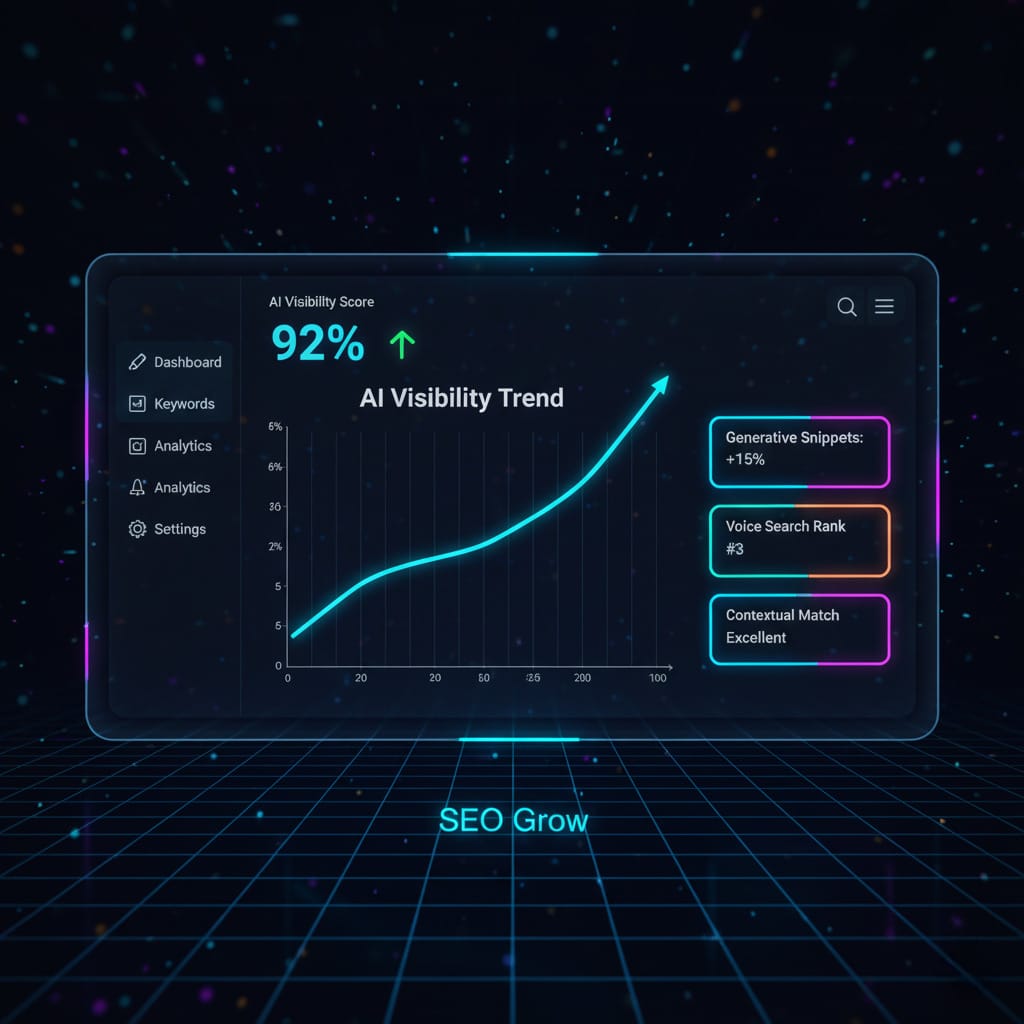
In this guide, I will break down the exact strategies we use at SEO Grow to drive visibility, highlight the critical AI SEO mistakes you must avoid, and show you how to measure your success using the right tools.
The Core Concept: From Ranking to “Citable Potential”
Before we dive into the tactics, understand the goal: We are not trying to “trick” the AI.
We are trying to make our content the path of least resistance for it. We call this “Citable Potential”1. An LLM wants to provide a safe, accurate, and structured answer. Your job is to be that answer.
This requires a hybrid approach:
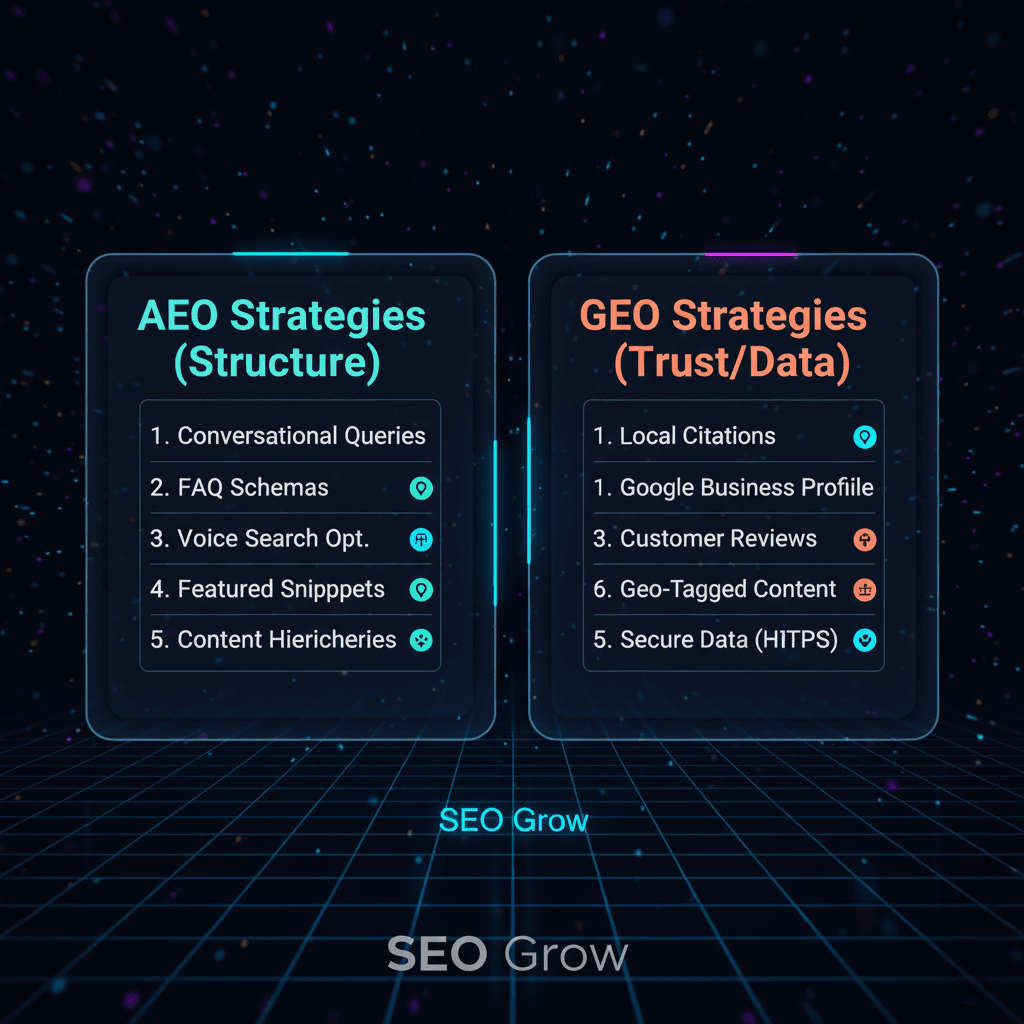
- AEO (Answer Engine Optimization): Structuring content for direct extraction.
- GEO (Generative Engine Optimization): Providing the trust signals and data density that LLMs crave.
Best SEO Strategies for AI Visibility Tools
To achieve visibility, your content must be machine-readable and statistically significant. Here are the specific strategies that move the needle.
1. Master the “Answer Target”
This is the single most effective tactic for AI visibility. An “Answer Target” is a 40–60 word definition or summary placed immediately after an H1 or H2 tag2.
- Why it works: It reduces the computational “effort” for the AI to identify the core answer.
- Best Practice: If your H1 is “What is Programmatic SEO?”, your very next sentence should define it directly (“Programmatic SEO is…”). Do not fluff the intro with “In today’s fast-paced digital world…”
2. Increase Data & Statistical Density
LLMs are prediction engines, but they are prone to hallucinations. To “ground” them, they prioritize content rich in hard data.
- Strategy: Inject your copy with specific percentages, dollar figures, dates, and countable nouns3.
- The Difference:
- Weak: “Most SEOs think AI is important.”
- Strong: “78% of enterprise SEOs prioritize AI visibility, according to our Q3 2025 survey.”
- Tool Tip: Our AI SEO Auditor specifically measures “Statistical Density” per 1,000 words to score this metric.
3. Implement “Provenance” Schema
Trust is a mathematical calculation for an AI. You must prove the “provenance” (origin) of your content.
- Best Practice: Use
Article,Author, andProfilePageschema to explicitly connect the content to a human expert4. - Why: Google’s E-E-A-T guidelines are baked into the training data. An anonymous article is a hallucination risk; a verified expert article is a citation source.
4. Adopt llms.txt Standards
A new standard is emerging: llms.txt. This is a file, similar to robots.txt, that gives specific instructions to AI agents on how to read your site5. Including this file signals to crawlers that you are “AI-native” and ready for interaction.
AI Local SEO: A Hidden Opportunity
While everyone focuses on global LLMs, AI Local SEO is where the immediate ROI lies for service businesses.
When a user asks ChatGPT, “Find me the best SEO agency in Tirana,” the AI looks for consistency across the web.
- N.A.P. Consistency: Ensure Name, Address, and Phone are identical everywhere.
- Local Schema: Use
LocalBusinessschema withgeocoordinates. - Reviews as Data: AI reads reviews to determine sentiment. Specific phrasing in reviews (e.g., “fast turnaround,” “ethical strategies”) becomes part of your semantic entity.
Top AI SEO Mistakes to Avoid
In our audits of hundreds of SaaS and agency sites, we see the same unforced errors repeatedly. These AI SEO mistakes can completely erase your visibility.
1. Blocking the Bots
You might think you are “protecting” your content, but blocking AI crawlers (like GPTBot or CCBot) in your robots.txt often means opting out of the future of search6. If they can’t read you, they can’t cite you.
2. “Wall of Text” Formatting
AI models prefer structure. A 2,000-word block of text is harder to parse than a well-structured list.
- The Fix: Use
<ul>and<ol>tags heavily7. Lists are the native language of instructional answers.
3. Ignoring “Context Coverage”
An AI builds a “Knowledge Graph” of a topic. If you only answer “What,” but ignore “How,” “Why,” and “Where,” your content is deemed incomplete8. You must cover the full semantic entity of your topic to be considered an authority.

The Future: Super-Intelligent AI-SEO
We are moving toward what some call super-intelligent AI-SEO. This isn’t about sci-fi; it’s about autonomousoptimization.
In the near future, we won’t just optimize for static algorithms; we will optimize for agents that act on behalf of users. Your website will need to be API-friendly, structurally rigid, and factually unimpeachable.
The best way to prepare for this future is to audit your “AI Readiness” today.
How to Audit Your Site for AI Visibility
You cannot improve what you do not measure. Traditional SEO tools (Semrush, Ahrefs) are excellent for keyword volume, but they are blind to generative signals. They cannot tell you if your Answer Target is clear or if your Data Density is sufficient.
That is why we built the AI SEO Auditor.
It is the first tool designed to apply a deterministic, 24-point check against the best practices for seo enhancing ai visibility.
- Check your Data Density.
- Verify your Answer Targets.
- Validate your Schema Provenance.
Don’t guess at your visibility. Run an AI SEO Audit now at ai-audit.seogrow.co and get a tactical blueprint to rank in the age of answer engines.
You may also want to read: