What Triggers an AI Overview? The New Logic of SEO, AEO, and GEO
Let’s be clear about one thing immediately: SEO is not dead.
Despite the panic you might see on X (Twitter) or LinkedIn, the arrival of Google’s AI Overviews (formerly SGE), ChatGPT Search, and Perplexity has not rendered your previous work obsolete. It has simply raised the bar.
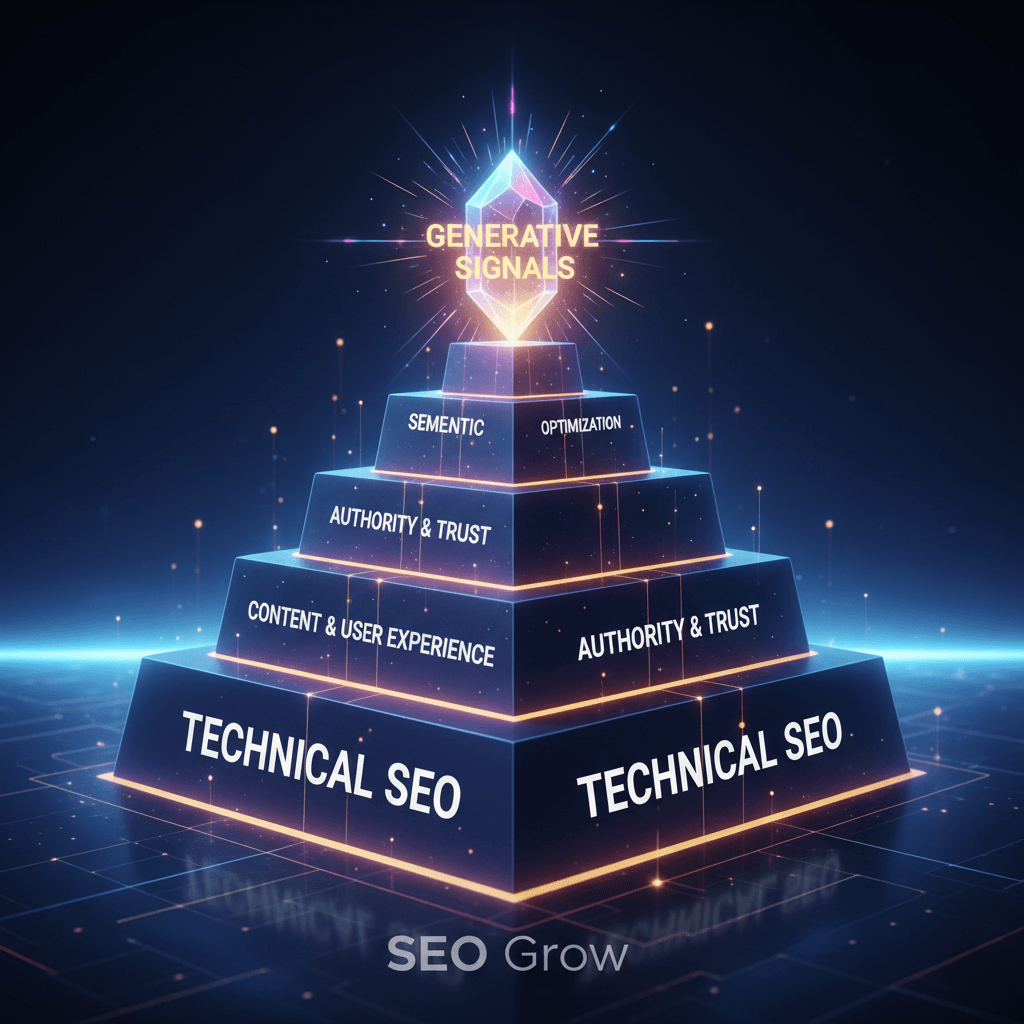
The “death of SEO” is a myth. In reality, traditional SEO is the bedrock that allows AI optimization to exist. You cannot build a skyscraper on quicksand, and you cannot build an AI-ready website without solid technical foundations.
Table of Contents
What triggers an AI Overview SEO result?
An AI Overview is triggered when a search engine’s Large Language Model (LLM) identifies a URL with high “Citable Potential.” This is determined by a specific set of weighted signals, primarily: the presence of a concise Answer Target (definition paragraph), high statistical data density, a logical heading hierarchy, and authoritative schema markup.
The AI is not looking for the “best” literary essay. It is looking for the most structurally sound, factually dense, and easily parsable answer to cite.
In this guide, I will break down the exact, deterministic signals—based on our own proprietary auditing logic at SEO Grow—that determine whether you get ignored or cited as the primary source of truth.
The Evolution: Why “Old” SEO is Your Secret Weapon
There is a misconception that you must abandon keyword research and technical audits to chase AI. This is false.
Think of AI optimization as a layer that sits on top of traditional SEO.
- Traditional SEO (The Foundation): Ensures your page is crawlable, indexable, and relevant. If Google cannot crawl your
robots.txtor parse your H1 tag, its AI cannot read your content. - AI SEO (The Layer): Ensures that once the page is crawled, the information is structured in a way that an LLM can easily extract, summarize, and trust.
If you neglect your title tags, meta descriptions, or internal linking (the “old” school), you become invisible. If you neglect data density and answer targets (the “new” school), you become visible but uncitable. You need both.
The 4 Pillars of AI Visibility
At SEO Grow, we do not guess. We use a rule-based model to audit websites. We have identified 24 specific signals that contribute to a page’s “AI-Readiness Score.”
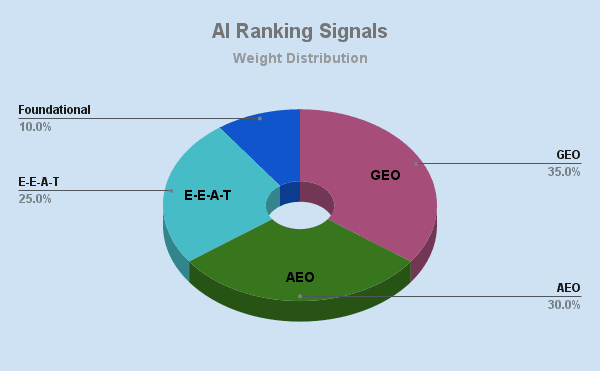
These signals fall into four distinct pillars.
Pillar 1: Foundational On-Page SEO (10% Weight)
This is where the “old SEO works” argument is proven. These signals ensure technical accessibility.
- Crawlability: If your
robots.txtblocks the crawler, the game is over before it starts. - Heading Hierarchy: A clear flow from H1 to H2 to H3 acts as a blueprint for the AI. It helps the model understand the relationship between concepts.
- Title Tags & Meta Descriptions: These remain critical for establishing immediate topic relevance.
Pillar 2: Answer Engine Optimization (AEO) (30% Weight)
This pillar focuses on formatting your content to be the path of least resistance for an answer engine.
- Answer Target Presence (Weighted 12%): This is arguably the most critical single tactic. You must place a 40 to 60 word “definition paragraph” immediately following your H1. This drastically reduces the computational effort required for an AI to extract an answer.
- List Formats: AI models love structure. Using
<ul>and<ol>tags for steps or comparisons makes your content machine-readable.
Pillar 3: Generative Engine Optimization (GEO) (35% Weight)
This is the core of modern “AI-Readiness.” These signals prove to the LLM that your content is factually dense and trustworthy enough to cite.
- Statistical & Data Density (Weighted 12%): LLMs hallucinate less when provided with hard numbers. We measure the density of percentages, statistics, and figures per 1,000 words. Content rich in specific data is “safer” for an AI to cite.
- Verifiable Citations: Using explicit parenthetical sourcing (e.g., “Source: Google Search Central”) signals a commitment to accuracy.
- Originality: Phrases like “our research” or “in our study” help differentiate your content from generic AI-generated slop.
Pillar 4: E-E-A-T & Authority (25% Weight)
Google needs to know you are a real business with real expertise.
- Author Bio Visibility: A visible author box linked to a full profile is a non-negotiable trust signal.
- About Us / Brand Signals: Links to transparency pages verify that a real entity stands behind the content.
The 24 Signals: A Deterministic Checklist
To move from theory to action, here is the breakdown of the specific logic we use in our AI SEO Auditor. These are the verifiable triggers you need to optimize for.
Technical & Foundational
- robots.txt: Verified accessible.
- Meta Robots: No
noindextags present. - Title Tag: Optimized for length and keywords.
- Meta Description: Present and efficient.
- Single H1: Only one primary heading per page.
- Hierarchy: Logical H1 to H6 structure.
- Internal Links: Connects to a wider cluster.
- External Links: Cites authoritative sources (like Google’s E-E-A-T guidelines).
Structuring for Answers (AEO)
- Answer Target: The 40–60 word definition block.
- List Usage: Presence of bullet points or numbered lists.
- FAQ Schema:
FAQPageJSON-LD markup. - HowTo Schema: Markup for instructional steps.
Optimizing for Generative Trust (GEO)
- Data Density: High frequency of numbers and stats.
- Originality Markers: First-person research language.
- Expert Quotes: Blockquotes from recognized authorities.
- Schema Provenance: Article and Author schema connecting content to creator.
- Tables: HTML tables for structured data presentation.
- Citations: Explicit source attribution.
- llms.txt: The new standard file for AI crawler permissions.
Authority & Depth
- Content Depth: Total word count.
- Context Coverage: Addressing Who, What, Where, Why, and How.
- Anchor Text: Descriptive internal link anchors.
- Author Visibility: clear bylines.
- Brand Transparency: Links to About/Contact pages.
How to Measure Your “Citable Potential”
The challenge with this new landscape is measurement. Legacy tools like Semrush or Ahrefs are excellent for keyword volume and backlink data, but they cannot tell you if your “Data Density” is high enough or if your “Answer Target” is correctly positioned for an LLM.
This measurement gap is why we built the AI SEO Auditor.
It is the industry’s first rule-based engine designed to score a page’s “AI-Readiness.” It doesn’t guess; it runs a deterministic check against the 24 signals listed above.
If you are serious about ranking in the new era of search, you need to stop guessing and start measuring. You can run a free audit of your primary landing page here to see exactly where you stand.
Final Thoughts: The Hybrid Approach Wins
Do not throw away your old SEO playbook. Polish it.
The winners of the next decade of search will be the SEOs who combine the technical rigor of the past with the structural and semantic requirements of the future. By focusing on Answer Targets, Data Density, and Schema, you trigger the AI Overview not by luck, but by design.
Optimize for the machine, but write for the human. That is the balance that wins.
You may also want to read about the: