Is Your Law Firm Invisible to AI Search? The 2026 AEO Guide
The way your potential clients find legal representation has fundamentally changed.
They are no longer typing “Personal Injury Lawyer New York” into a search bar and browsing ten blue links. They are having conversations.
They ask Gemini, ChatGPT, or Perplexity specific questions like this.
“Which lawyer in New York has the highest success rate with medical malpractice and offers free consultations?”
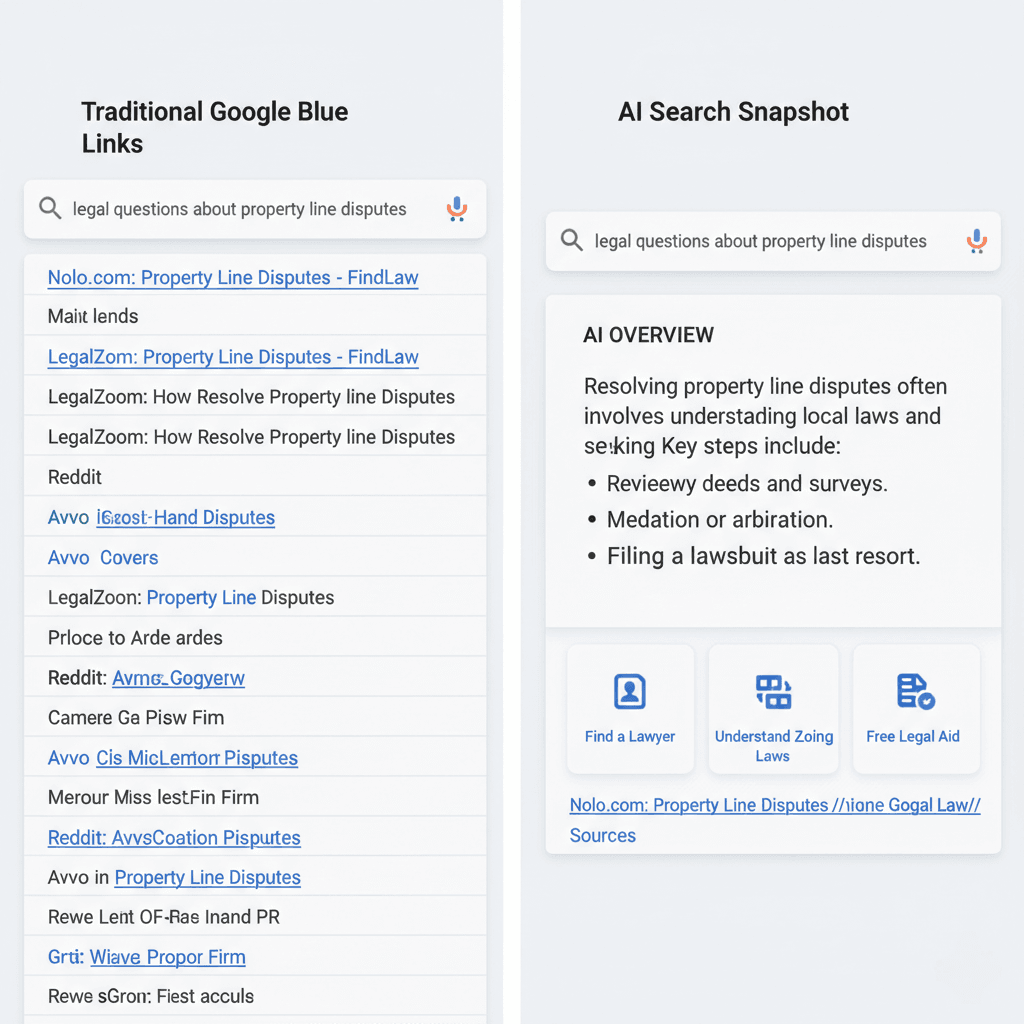
This is the new reality. If Google’s AI does not “cite” you in that answer, you do not exist. It does not matter if you are Rank #1 in traditional organic search. If the AI cannot verify your data, it will not recommend you.
This is the era of AEO (Answer Engine Optimization). It is the evolution of SEO specifically designed for AI agents.
Table of Contents
Why AI Search is Different for Legal Practices
Legal marketing has always been competitive. However, the shift to Generative Search introduces a new layer of complexity known as the “YMYL Hurdle.”
Google classifies the legal sector as “Your Money or Your Life” (YMYL). This means the standards for accuracy are significantly higher than for other industries. AI models are strictly programmed to avoid “hallucinations” in this niche. They will not guess. They will only cite sources they view as mathematically irrefutable.
Traditional SEO was about relevance. You optimized for keywords to show you were relevant to the topic.
AEO is about verifiability. You optimize data so an AI agent can confirm you are a licensed, physical, and successful entity.
The ROI of this shift is massive. Appearing in an AI snapshot (the direct answer at the top of the search) establishes immediate trust. It signals that the search engine itself validates your authority.
The 3 Pillars of Legal AEO
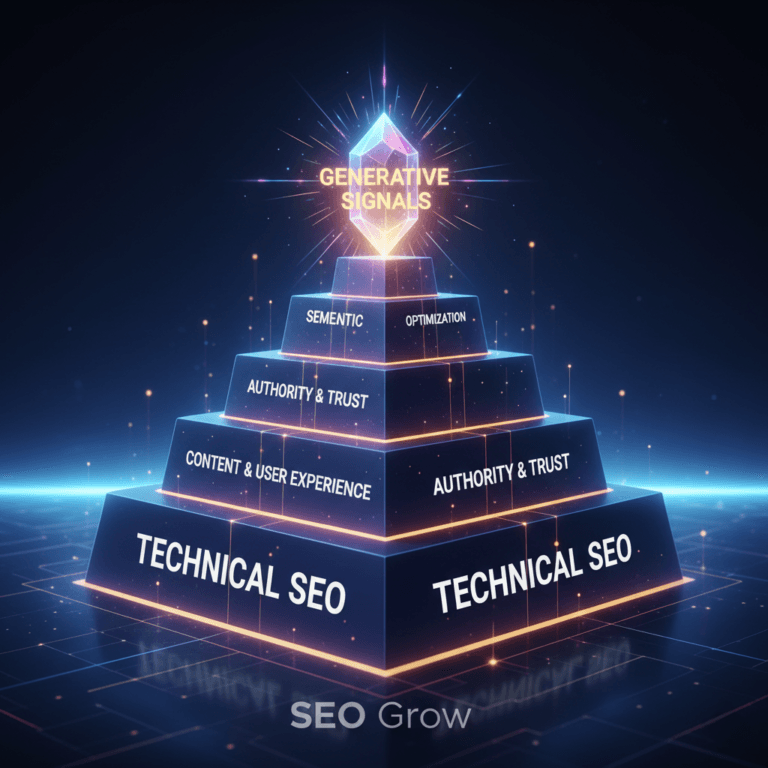
To capture this new real estate, you must stop thinking like a blogger and start thinking like a database. Our proprietary analysis at SEO Grow identifies three critical pillars for legal AEO.
Pillar 1: Entity Resolution (Who are you?)
AI agents do not “read” websites like humans do. They look for entities. You must use specific code to prove you are a licensed entity rather than just a marketing site. This involves leveraging Schema markup and Bar Association data to create a digital fingerprint that AI can verify.
Pillar 2: Information Density (What do you know?)
Generic blogs about “What to do after a car accident” are now obsolete. AI can generate that content in seconds. To be cited, your content must have high “Information Density.” This means moving away from fluffy content to data-rich, specification-heavy resources that AI agents need to build their answers.
Pillar 3: Trust Anchors (Who vouches for you?)
E-E-A-T (Experience, Expertise, Authoritativeness, and Trustworthiness) is no longer just a concept. It is a mathematical signal. LLMs digest reviews, citations, and awards to determine sentiment. If your digital footprint has discrepancies, the AI will distrust your data and skip your firm entirely.
Check your Firm’s AI Score
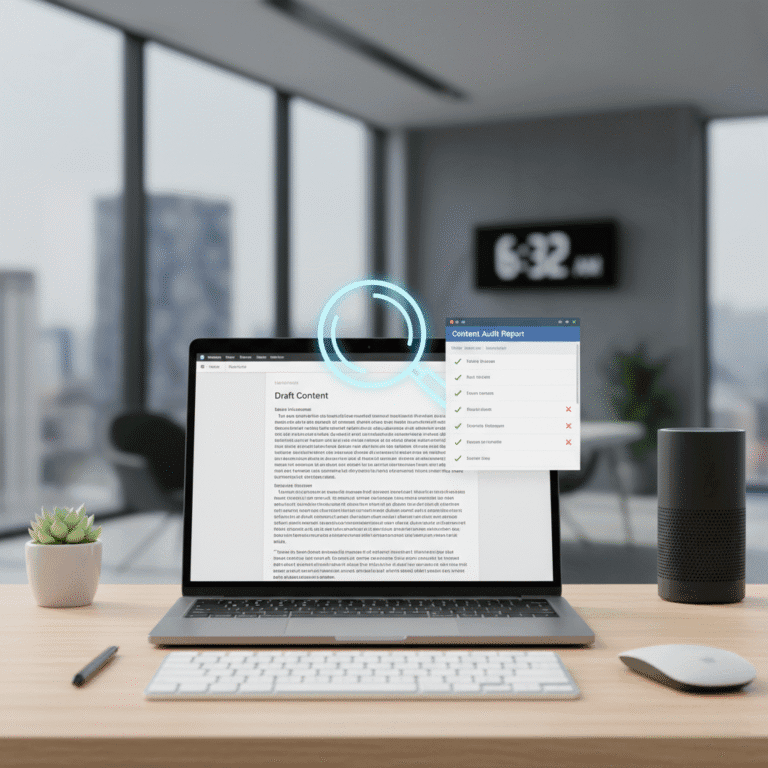
Don’t wait for your traffic to drop. Use our proprietary AI SEO Auditor to see if your firm is being ‘read’ or ‘ignored’ by Google’s new AI algorithms.
You may also want to read about:
The 2026 AEO Checklist for Law Firms
We have compiled the essential technical requirements to ensure AI Engines like Gemini, Perplexity, and SearchGPT recommend your firm.
1. Entity Resolution & Schema Precision
AI engines need to connect your firm to a specific “Entity” graph.
- Local Business & LegalService Schema: Are you using the specific
LegalServiceschema (not justLocalBusiness) to define your practice area? - Attorney Profile Schema: Does every partner have an individual
Personschema linked to their Bar Association profile? - Jurisdiction Clarity: Does your code explicitly state the jurisdictions where you are licensed to practice? LLMs prioritize “licensed” over “relevant.”
2. Answer-Targeted Content (The “Zero Click” Hook)
AI models look for direct answers to complex legal questions.
- The “Definition” Block: Do your service pages start with a clear, 2-sentence definition of a legal concept (e.g., “What is a contingency fee in [State]?”)?
- Q&A Heading Structure: Are you using H2s and H3s that mirror actual client questions? (e.g., “How long do I have to file a claim in [City]?”)
- Data Density: Does your content include specific success stats (e.g., “$2M+ recovered in 2025”)? AI engines cite firms that provide hard data points over vague promises.
3. Verified E-E-A-T (The “Trust” Signal)
In YMYL niches, LLMs are programmed to be skeptical of unverified claims.
- Authoritative Backlinks: Are you cited on .gov, .edu, or official Bar Association websites? Our auditor checks for these specific “Trust Anchors.”
- Citation Consistency: Is your NAP (Name, Address, Phone) identical across the Bar Association, Yelp, and your Footer? Discrepancies lead to “Hallucinations,” causing AI to skip your firm.
- Review Sentiment Analysis: Are your Google Business Profile reviews mentioned in LLM responses? AI engines now “read” reviews to determine sentiment before recommending a lawyer.
4. The “Technical Bridge” for LLMs
You must speak the language of the Large Language Model.
- llms.txt Implementation: Does your root directory contain a summary file that tells AI agents exactly what your firm specializes in?
- Table-Based Data: Are your fee structures or case types presented in HTML tables? LLMs ingest tables 40% more accurately than paragraph text.
Pro Tip: Don’t guess if your firm is AI-ready. Most legal websites fail on “Citation Density” and “Entity Schema.” Run a free Legal AEO Audit here to see exactly how your firm scores in Google’s new AI environment.
Case Study: The “Invisible” Firm vs. The “Cited” Firm
We analyzed two firms competing for the same “Medical Malpractice” queries in Chicago.
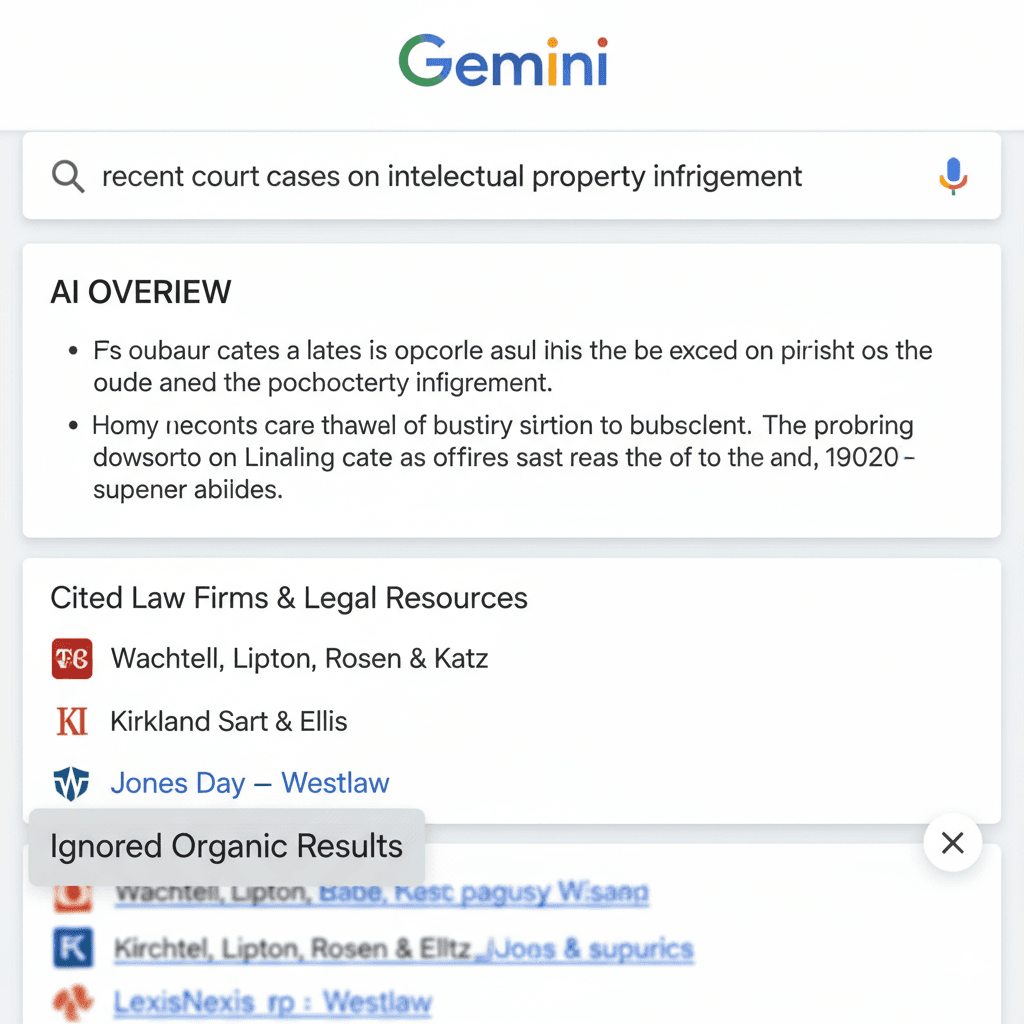
The Invisible Firm had excellent traditional SEO. They ranked #2 organically. However, their content was buried in long paragraphs and they lacked structured data. When we asked Gemini for recommendations, this firm was nowhere to be found. The AI skipped them because it was “too much work” to verify their success rates.
The Cited Firm ranked #5 organically but dominated the AI Snapshot. Why? They had high “Data Density” and clear Q&A structures. They used an llms.txt file to guide the crawler. The AI cited them as the “Primary Source” because their data was structured for machine consumption.
How to Transition Your Marketing Strategy
The legal industry is often slow to change. This presents a massive opportunity for early adopters.
You must stop writing for bots and start answering for agents.
- Adopt the Question-Answer Format: Restructure your content to directly answer the “Who, What, Where, and How” immediately after your headings.
- Clean up your Technical Foundation: Ensure your
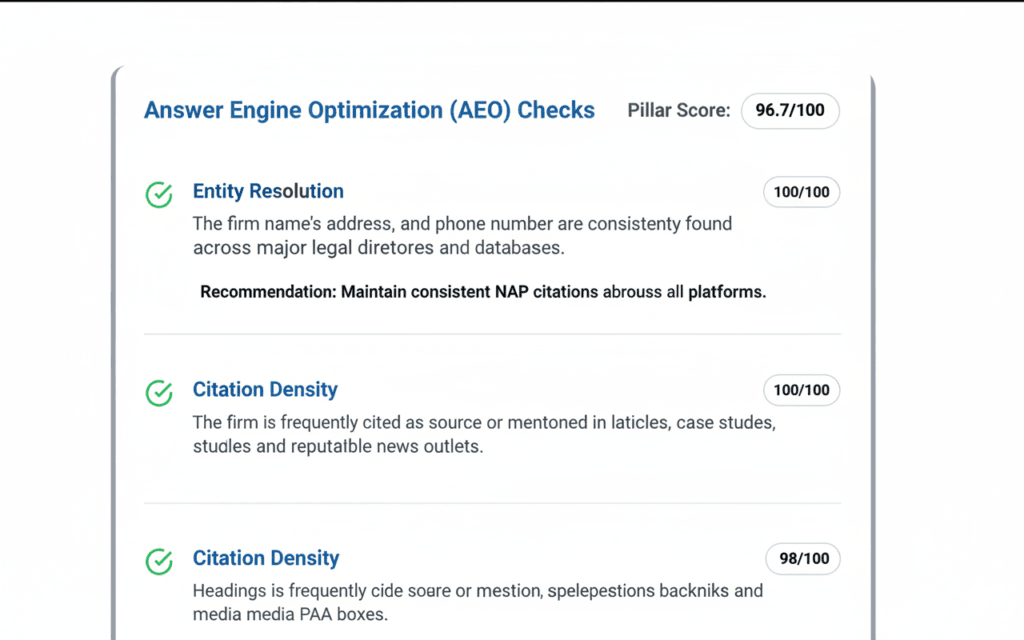
LegalServiceschema is flawless and validates against Google’s LegalService Schema documentation. - Run a Deterministic Audit: Manual checks are impossible for 20+ intricate AI signals. You need a tool that sees what the AI sees.
The First-Mover Advantage
The shift to AEO is not just an algorithm update. It is a fundamental change in how clients choose their lawyers.
By adopting AEO now, you capture the “AI Snapshot” real estate before your competitors even know it exists. You move from being a search result to being the answer.
Ready to lead the era of Generative Search? Start your Free Law Firm AEO Audit today.
Frequently Asked Questions about Legal AEO
What is AEO for law firms?
AEO (Answer Engine Optimization) for law firms is the process of optimizing legal content to appear in AI-generated answers, such as Google AI Overviews and ChatGPT. Unlike traditional SEO which focuses on ranking links, AEO focuses on becoming a cited source of truth for specific legal queries.
How is AEO different from SEO for lawyers?
AEO prioritizes verifiability and structure over keywords. While SEO aims to rank a webpage, AEO aims to have the law firm’s data (such as success rates, practice areas, and locations) directly cited by an AI agent as the answer to a user’s question.
Why is Schema markup important for legal marketing?
Schema markup is critical because it acts as a translator for AI. Specifically, LegalService schema tells search engines explicitly that a website belongs to a licensed attorney, defines the practice areas, and validates the jurisdiction, which helps prevent AI hallucinations.
You may also want to read about: