Semantic SEO Writing for AEO: A Technical Guide to NLP Content Optimization
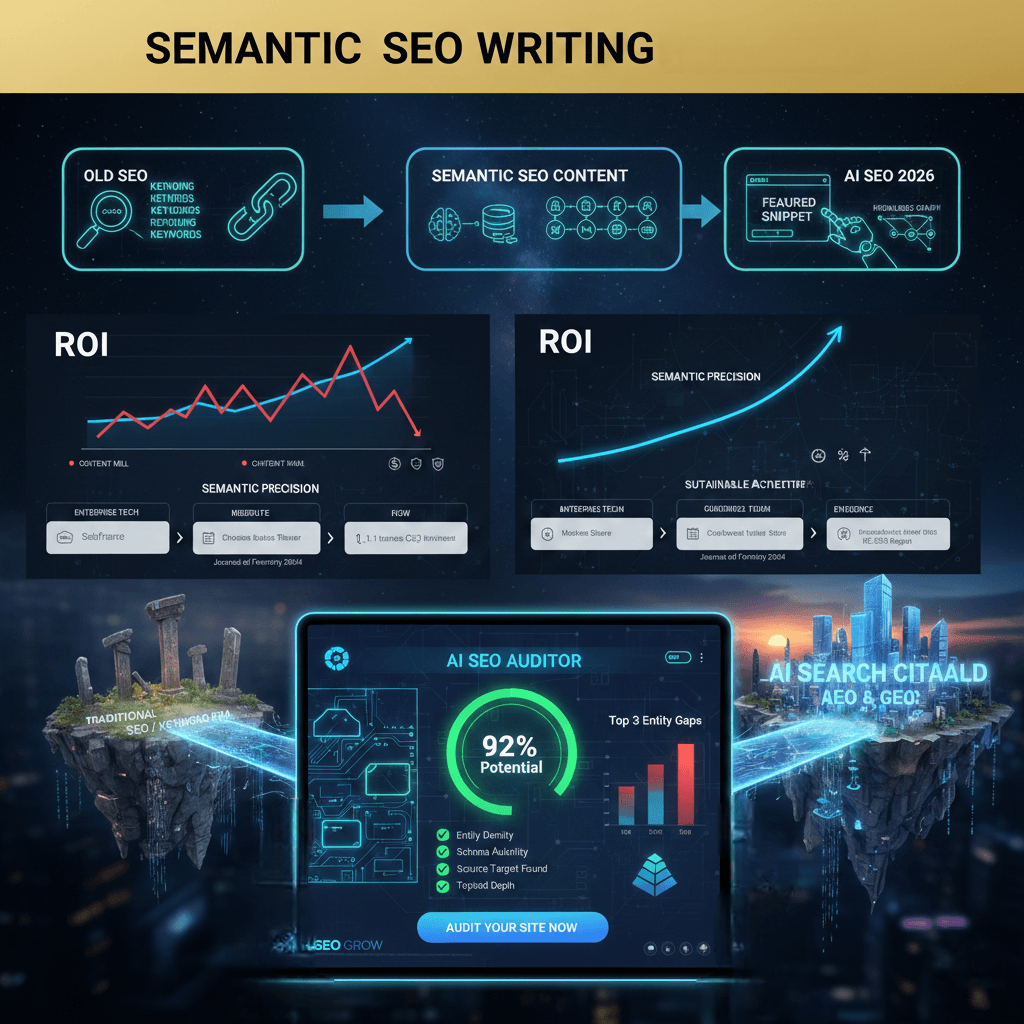
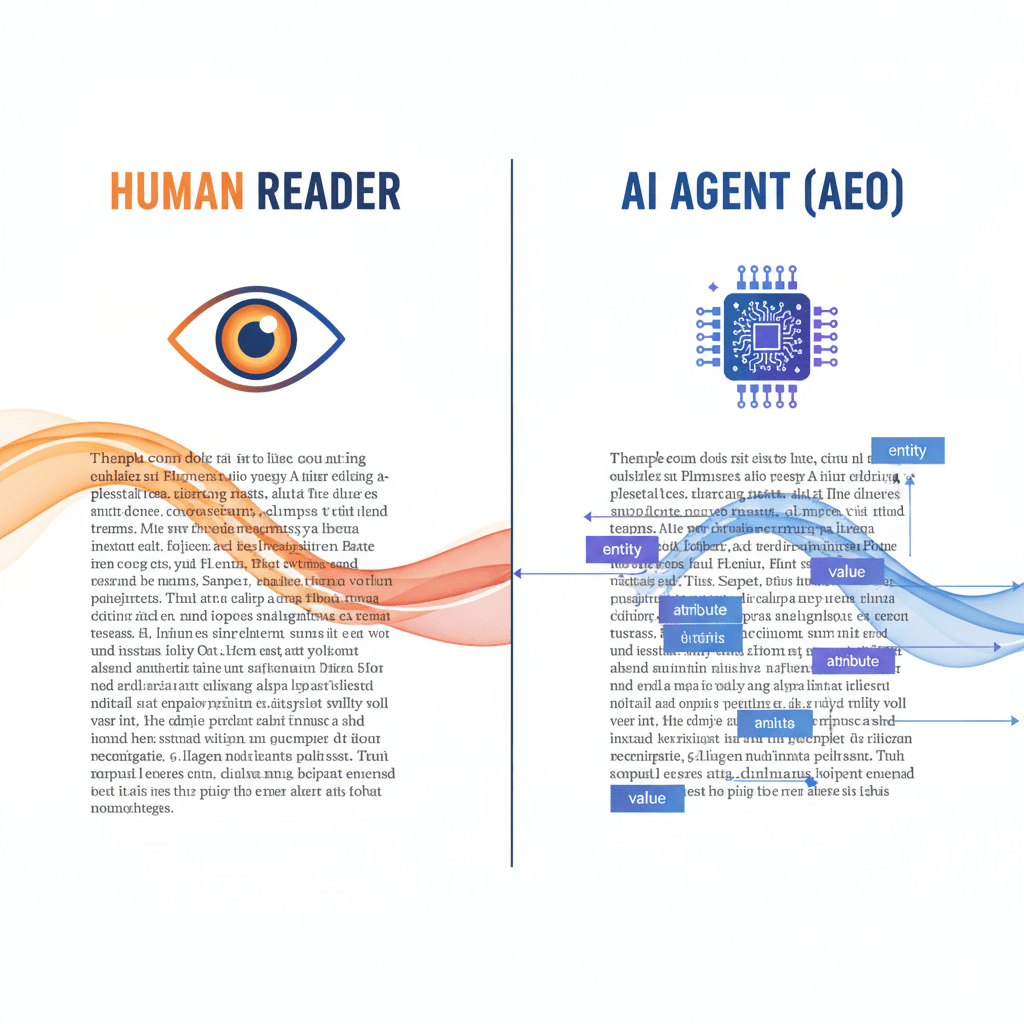
Semantic SEO Writing for AEO is the practice of structuring content using the Entity-Attribute-Value-Evidence formula. This method ensures that AI agents (SearchGPT, Gemini) can verify and cite your content as a Primary Source of Truth.
Natural Language Processing (NLP) models now dictate the visibility of B2B SaaS brands. Digital marketing has moved beyond the era of keyword density. Repeating phrases to signal relevance creates a strategic liability for modern agencies. Semantic SEO Writing connects human readability with machine precision.
Answer Engine Optimization (AEO) and Generative Engine Optimization (GEO) represent the new benchmarks for search success. Search engines do not merely index pages anymore. Large Language Models (LLMs) parse facts and synthesize answers from trusted documents. At SEO Grow, we use this architectural blueprint to ensure our clients dominate AI-first environments.
Table of Contents
The ROI of Semantic Precision
Strategic economic gains result from transitioning to a semantic writing model. The traditional “content mill” approach produces high volumes of low utility output. Semantic models prioritize high precision assets instead. While the initial effort per article increases: the strategic returns grow exponentially.
Precision-Based Rankings emerge when search engines extract facts easily. NLP algorithms prioritize content with clear entity relationships. High visibility for competitive queries follows this technical clarity.
Brand Trust increases through factual density. Expert readers ignore marketing fluff. Direct and evidence-backed statements eliminate the “bounce” behavior common in vague prose.
Defensive Moats form around semantic assets. AI can generate infinite noise. Machines cannot easily replicate evidence-backed entity relationships without high-quality source documents. This technical gap ensures long-term organic channel ownership for SaaS founders.
The Golden Formula: Entity-Attribute-Value-Evidence
The Golden Formula serves as the foundation of NLP-optimized writing. This structure allows AEO engines to populate knowledge graphs efficiently. GEO engines like Perplexity or SearchGPT cite this content as a primary source because the data is verifiable.
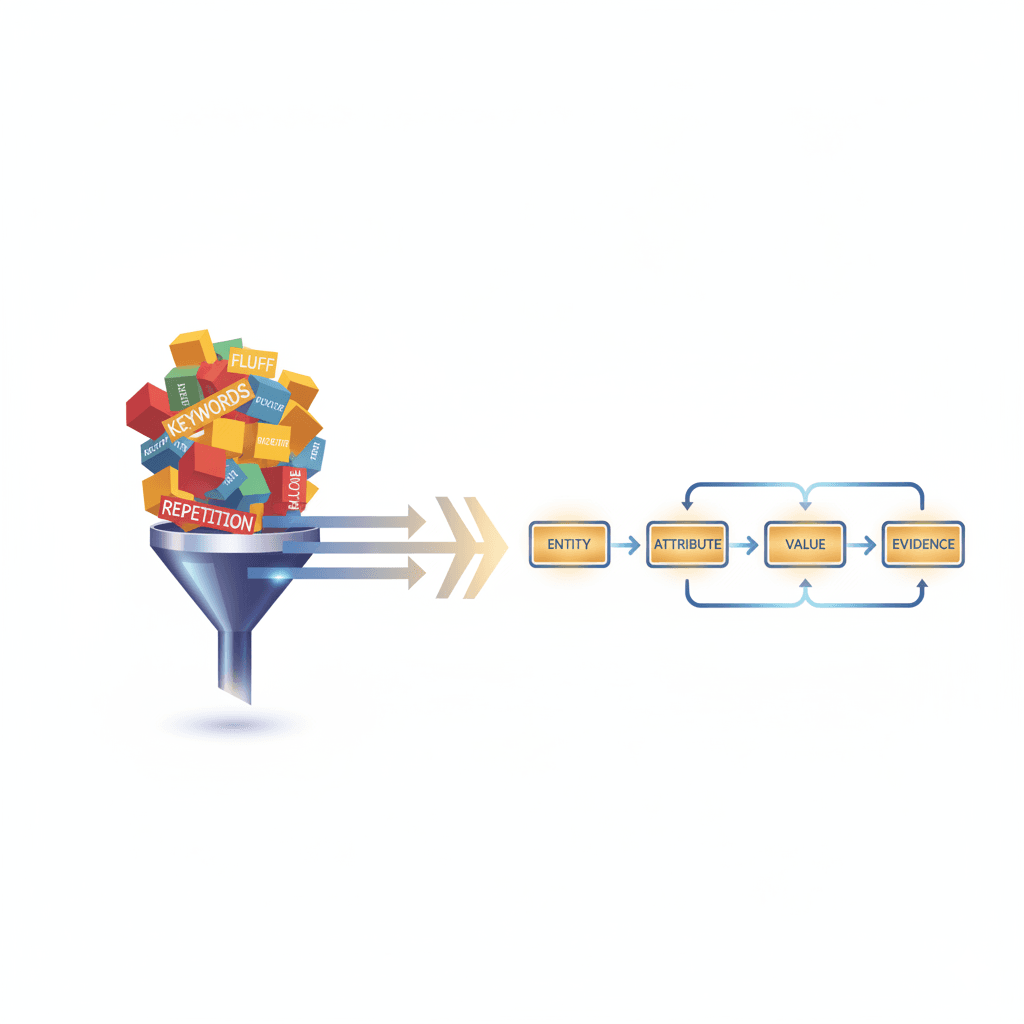
The Formula: Entity → Attribute → Value → Evidence
The Formula in Action: Enterprise Tech and Architecture
- Entity: Salesforce
- Attribute: Market Share
- Value: 23%
- Evidence: 2023 IDC Worldwide Software Tracker
- Entity: Cross-Laminated Timber (CLT)
- Attribute: Carbon Sequestration
- Value: 1.1 tonnes of CO2 per cubic meter
- Evidence: 2024 Journal of Sustainable Forestry
Information Extraction: Vague vs. Semantic Precision
| Vague Prose | Semantic Construction (NLP Optimized) |
| Vague: Our software is very popular and helps teams work much better than before. | Semantic: Salesforce currently holds a 23% CRM market share according to the 2023 IDC Worldwide Software Tracker. This dominance allows teams to integrate 40% more third-party APIs than competing platforms. |
| Vague: Sustainable buildings use modern materials to help the environment. | Semantic: Sustainable Architecture utilizes Cross-Laminated Timber to achieve 1.1 tonnes of CO2 sequestration per cubic meter as verified by the 2024 Journal of Sustainable Forestry. |
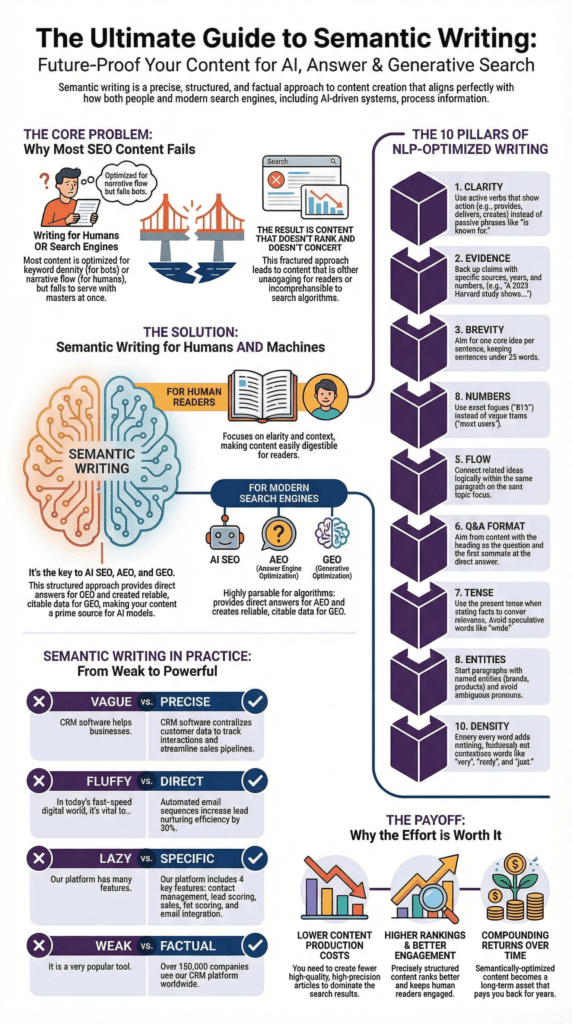
The 10 Pillars of NLP-Optimized Content
The Prime Directive: State WHO does WHAT with strong verbs and facts. Semantic writing follows a strict Standard Operating Procedure (SOP). Every sentence must adhere to these ten technical pillars.
I. Clarity
Clarity requires a “Subject-Verb-Object” structure. Writers must eliminate linguistic distance between the actor and the action.
- Before: Marketing software is often known for helping users with their social media needs.
- After: Marketing software automates social media scheduling to reduce manual labor.
II. Evidence
Evidence provides the “Proof of Expertise” required for E-E-A-T. Every factual claim must include a source and a date.
- Before: Most experts agree that AI is changing the way we work.
- After: Gartner 2023 reports that AI-driven automation improves operational efficiency by 25%.
III. Brevity
Brevity maximizes the efficiency of LLM tokenization. Sentences must contain 25 words or fewer.
- Before: If you want to make sure that your content ranks well you need to follow these rules because the search engines really like them.
- After: Semantic rules improve search rankings. LLMs prioritize structured data over vague prose.
IV. Numbers
Numbers replace vague quantifiers. Specificity builds authority and prevents machine hallucinations.
- Before: Many users saw a significant increase in traffic.
- After: 82% of users reported a 40% increase in organic traffic within six months.
V. Flow
Flow connects concepts in a logical “X → Y → Z” chain. Each paragraph focuses on one discrete entity to prevent context fragmentation.
- Before: SEO is hard. We also like content marketing. Backlinks matter too.
- After: Semantic writing improves indexing. Better indexing leads to higher rankings. Higher rankings drive revenue.
VI. Q&A Format
Q&A Format targets Featured Snippets and voice search. Headers must pose a direct question. The following paragraph must provide a direct answer.
- Before: The Definition of GEO.
- After: What is GEO? Generative Engine Optimization is the process of optimizing content for visibility in AI-driven search results.
VII. Tense
Present Tense establishes factual authority. Writers must avoid modal verbs like “might” or “could” which introduce uncertainty.
- Before: Our tool might help your team work better.
- After: The AI SEO Auditor identifies technical gaps in content strategy.
VIII. Entities
Entities must start every paragraph. Pronouns like “It” or “This” obscure the micro-context for NLP parsers.
- Before: It analyzes the semantic signals on a page.
- After: The AI SEO Auditor analyzes 24 specific semantic signals to determine AI-readiness.
IX. Density
Density measures the ratio of facts to words. Writers must delete every word that does not contribute to the logic of the sentence.
- Before: Basically, it is actually quite important to understand SEO.
- After: SEO remains a primary driver of digital growth.
X. Hierarchy
Hierarchy organizes information from broad categories to specific parts. This structure assists search engines in mapping the relationship between entities.
- H1: FOOTWEAR
- H2: Sneakers
- H3: Sole
Precision in Action: The Verb Guide
Large Language Models prioritize strong verbs to identify intent. The following categories provide the necessary precision for technical B2B SaaS copy.
| Category | Recommended Strong Verbs |
| Health / Amount | increase; decrease; reduce; expand |
| Skills / Quality | improve; develop; master; refine |
| Making / Logic | produce; generate; construct; synthesize |
| Giving / Delivery | provides; delivers; transmits; allocates |
Sentence Templates for NLP
- Definition: “X is a [type] that [does action].”
- Process: “X works by [method].”
- Benefit: “The [number] benefits of X are [list].”
- Causality: “X happens because [reason].”
| Core Pillar | Writing Principle | Suboptimal Example (SEO Grow Optimized) | Semantic/AEO Optimized Example (SEO Grow Optimized) | AEO & GEO Impact (Inferred) |
| Q&A FORMAT | Heading = Question; First sentence = Direct Answer. | The Definition of GEO. (Paragraph: There are many ways to define this new field…) | What is GEO? GEO is the process of optimizing content for visibility in AI-driven search engines. | Directly feeds Answer Engines the ‘featured snippet’ style content they prioritize. |
| ENTITIES | Start paragraphs with named entities; avoid starting with ‘It’, ‘They’, or ‘This’. | It is a powerful tool for SEO. | The AI SEO Auditor analyzes 50+ semantic signals. | Facilitates Entity Extraction, ensuring the search engine knows exactly which ‘thing’ the content is about. |
| CLARITY | Use ‘X does Y’ instead of ‘X is known for’ to define actions. | AI SEO tools are known for providing efficiency. | AI SEO tools automate technical audits to save time. | Enhances direct answer extraction by providing clear subject-predicate relationships for NLP models. |
| EVIDENCE | Cite Source + Year + Number for credibility. | Many sites saw traffic growth last year. | Search Engine Land 2023: AI-optimized sites saw a 40% traffic increase. | Boosts E-E-A-T signals which GEO systems use to verify factual accuracy and source authority. |
| BREVITY | One idea per sentence. Max 25 words per sentence. | When you are looking for an SEO agency it is vital to find one that understands AEO and GEO and semantic writing because those are the future of search. | Effective SEO agencies master AEO and GEO frameworks. | Reduces token complexity, allowing LLMs to parse and summarize information without losing context. |
| NUMBERS | Always use exact counts and percentages instead of vague quantifiers. | Most users prefer fast websites. | 88% of users leave websites with over 3-second load times. | Provides specific data points for generative engines to cite as ‘hard facts’ in response summaries. |
| TENSE | Use present tense for facts; avoid modal verbs (can, should, might). | Our tool might help you rank better. | The AI SEO Auditor identifies E-E-A-T gaps in content. | Increases the ‘factualness’ score in NLP analysis by stating information as definitive reality. |
| SEMANTIC HIERARCHY | Ensure sub-topics (H2s) strictly support the main topic (H1). | H1: AI SEO Guide. H2: My favorite vacation spots. | H1: AI SEO Guide. H2: Understanding Generative Engine Optimization. | Reinforces the knowledge graph structure of the page, making it easier for AI to categorize the content. |
| FLOW | Connect ideas using X -> Y -> Z logic on the same topic per paragraph. | SEO is changing. Also, content is important. Don’t forget about backlinks. | Semantic writing improves indexing. Better indexing leads to higher rankings. Higher rankings drive more organic revenue. | Improves the semantic proximity of related concepts, helping LLMs understand topical relevance. |
| DENSITY | Every word must add meaning; remove contextless filler words. | In today’s world, it is really quite important to understand SEO. | SEO remains a primary driver of digital growth. | Maximizes Information Density, allowing AI models to extract more value from fewer tokens. |
Automating Excellence with the AI SEO Auditor
Semantic writing transforms a webpage into a structured data asset. This methodology aligns with the highest standards of E-E-A-T. Agencies must bridge the gap between traditional keywords and AI-driven synthesis.
Verification is essential for technical accuracy. The AI SEO Auditor analyzes 24+ semantic signals. This tool evaluates Answer Target Presence and factual density. Marketing professionals use the auditor to secure authority in the future of search.
Audit your content today to ensure your writing dominates the AEO landscape.
You may want to read about: