
AEO for Healthcare: Medical Practice SEO for AI Platforms
The doctor-patient connection is changing. It is no longer starting with a referral from a friend or a brochure in a waiting room.
It starts with a question.
Consider this scenario. A patient picks up their phone and asks: “What is the best dermatology clinic near me for adult acne that accepts Blue Cross Blue Shield?”
In the past, Google would simply list clinics that matched the keywords “dermatology” and “acne.” Today, AI agents like Gemini, ChatGPT, and Perplexity act as filters. If the AI cannot verify your insurance acceptance, your location, or your board certifications in milliseconds, it will skip you. It will recommend a clinic that has a “machine-readable” profile instead.
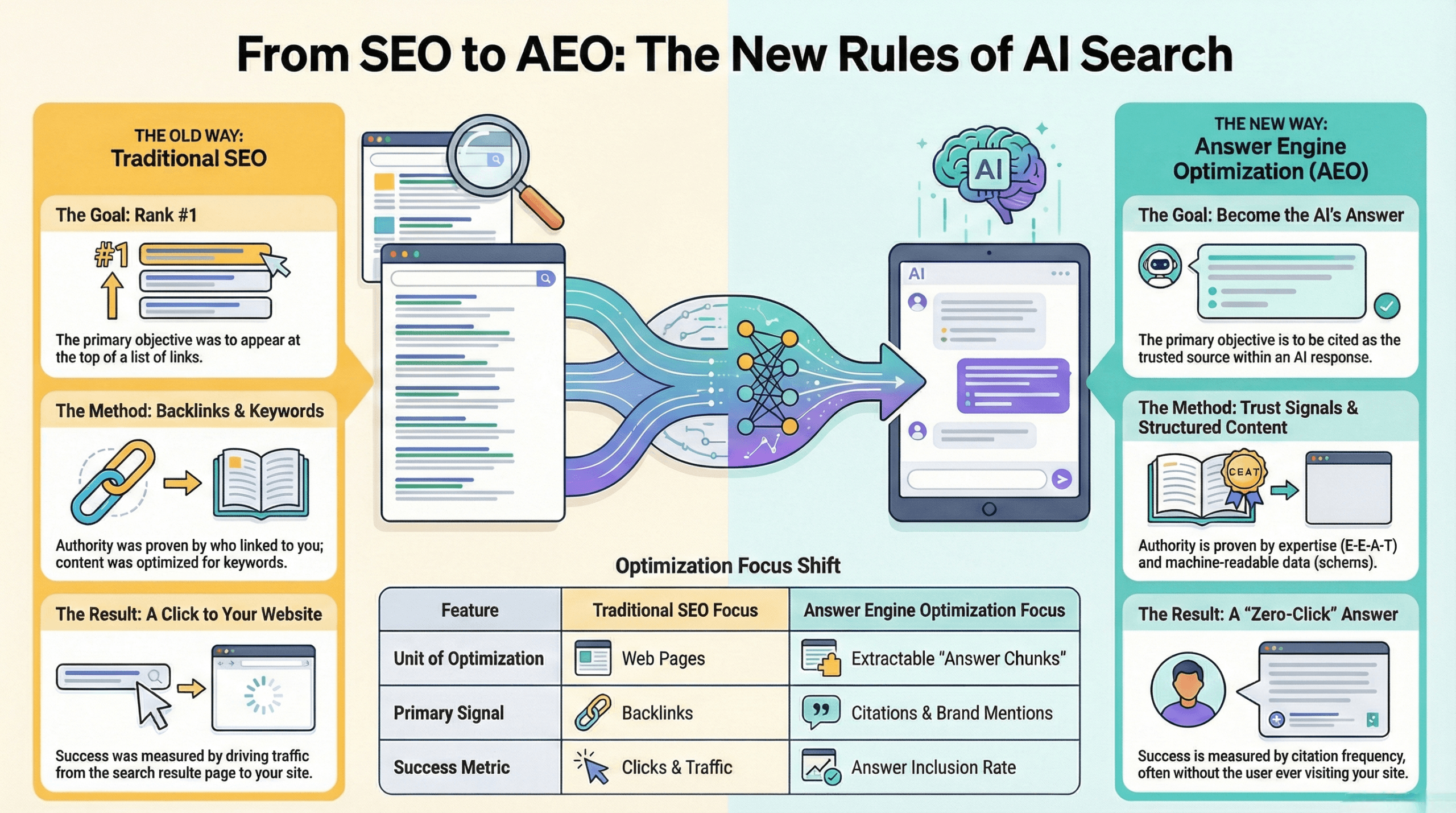
This is the core thesis of the new digital landscape. Traditional SEO helps you rank in a list. AEO (Answer Engine Optimization) helps you get referred by the AI.
Table of Contents
The “Trust Barrier” in Medical AI Search
Healthcare marketing faces a unique challenge known as the “Hallucination Guardrail.”
AI engines are terrified of giving bad medical advice. Because healthcare is a YMYL (Your Money or Your Life) sector, models like GPT-4 and Gemini are strictly programmed to avoid guessing. They will only cite clinics and practitioners that display “bulletproof” authority signals.
This is why general SEO strategies often fail for medical practices. You can have excellent keywords and a fast website. However, if your NPI (National Provider Identifier) or medical certifications are not linked via Schema markup, the AI views you as a “low-trust” entity.
AI platforms do not just look for relevance; they look for verification.
The 3 Pillars of Healthcare AEO
To ensure your medical practice or surgical center is visible to these new platforms, you must build a strategy based on data density and trust.
1. Credential Verification (Entity SEO)
AI agents need to know exactly who you are. This goes beyond a bio on an “About Us” page. It requires connecting your doctors’ digital profiles to official medical boards and health databases using structured data. When an AI can mathematically verify a surgeon’s credentials against an authoritative source, it is far more likely to cite them as a trusted expert.
2. Service Transparency (Data Density)
Ambiguity is the enemy of AEO. AI agents favor specific, structured data. This is particularly true for “Medical Supplies” and “Specialty Clinics” where specifications matter.
- Do not just write: “We offer affordable rates.”
- Do write: Create HTML tables listing specific treatments, CPT codes (if applicable), and a verified list of accepted insurance providers.
AI models ingest table data 40% more effectively than paragraph text.
3. Patient Sentiment (The Social Proof Agent)
Your reviews are no longer just for humans. AI “reads” the context of your patient reviews to determine expertise. It analyzes sentiment regarding bedside manner, wait times, and treatment outcomes. A high volume of positive, context-rich reviews serves as a massive “Trust Anchor” for Local SEO and AI recommendations.
Is Your Medical Practice AI-Verified?
Medical AI agents prioritize ‘Trust Signals’ over keywords. Use our Healthcare AI Auditor to see if your clinic meets the 2026 AEO standards for patient safety and authority.
The Medical AEO Technical Checklist
To bridge the gap between your clinic and AI platforms, you must ensure your technical foundation is sound. Use this checklist to audit your digital presence.
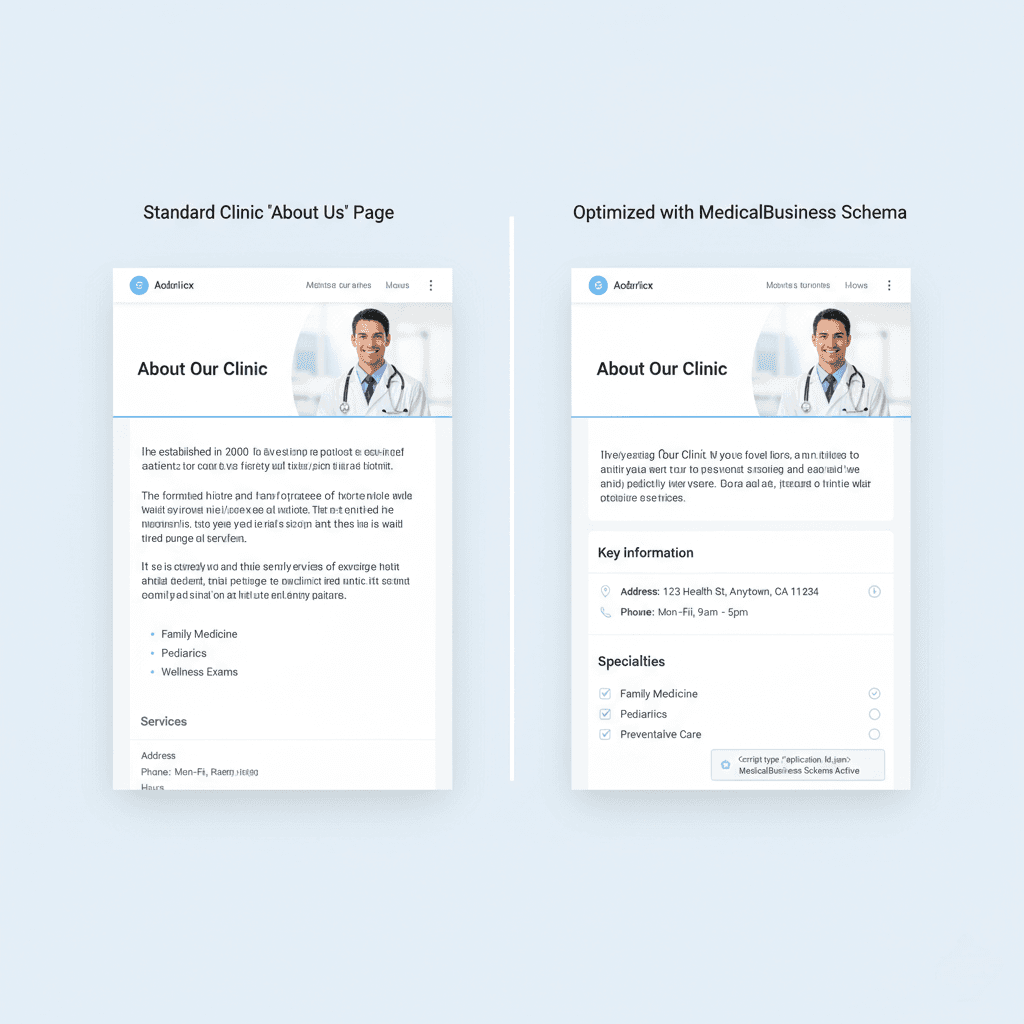
- MedicalBusiness Schema: Are you using the specific
MedicalBusinessorPhysicianschema? You must includeknowsAboutandmedicalSpecialtyproperties to define your exact field. - Insurance Linkage: Does your site have a machine-readable list of accepted insurance plans? AI will often filter out doctors if it cannot confirm coverage costs for the user.
- Board Certifications: Are your practitioners’ credentials linked to external authoritative sources? Link directly to the AMA (American Medical Association), local health boards, or hospital affiliations to prove legitimacy.
- Condition-Based Q&A: Does your site answer “Patient Intent” questions? You should have Answer Targets that address queries like “How to prepare for a [Procedure] at our clinic” or “Recovery time for [Surgery]”.
Technical Resource: The “Trust” Code
Most web developers miss this. Copy the code snippet below and ask your developer to add it to your clinic’s homepage header. This tells AI agents exactly what you specialize in.
<script type="application/ld+json">
{
  "@context": "https://schema.org",
  "@type": "MedicalBusiness",
  "name": "Your Clinic Name",
  "medicalSpecialty": "Dermatology",
  "knowsAbout": ["Adult Acne", "Cosmetic Dermatology", "Skin Cancer Screening"],
  "availableService": [
    {
      "@type": "MedicalProcedure",
      "name": "Acne Treatment",
      "procedureType": "Non-surgical"
    }
  ]
}
</script>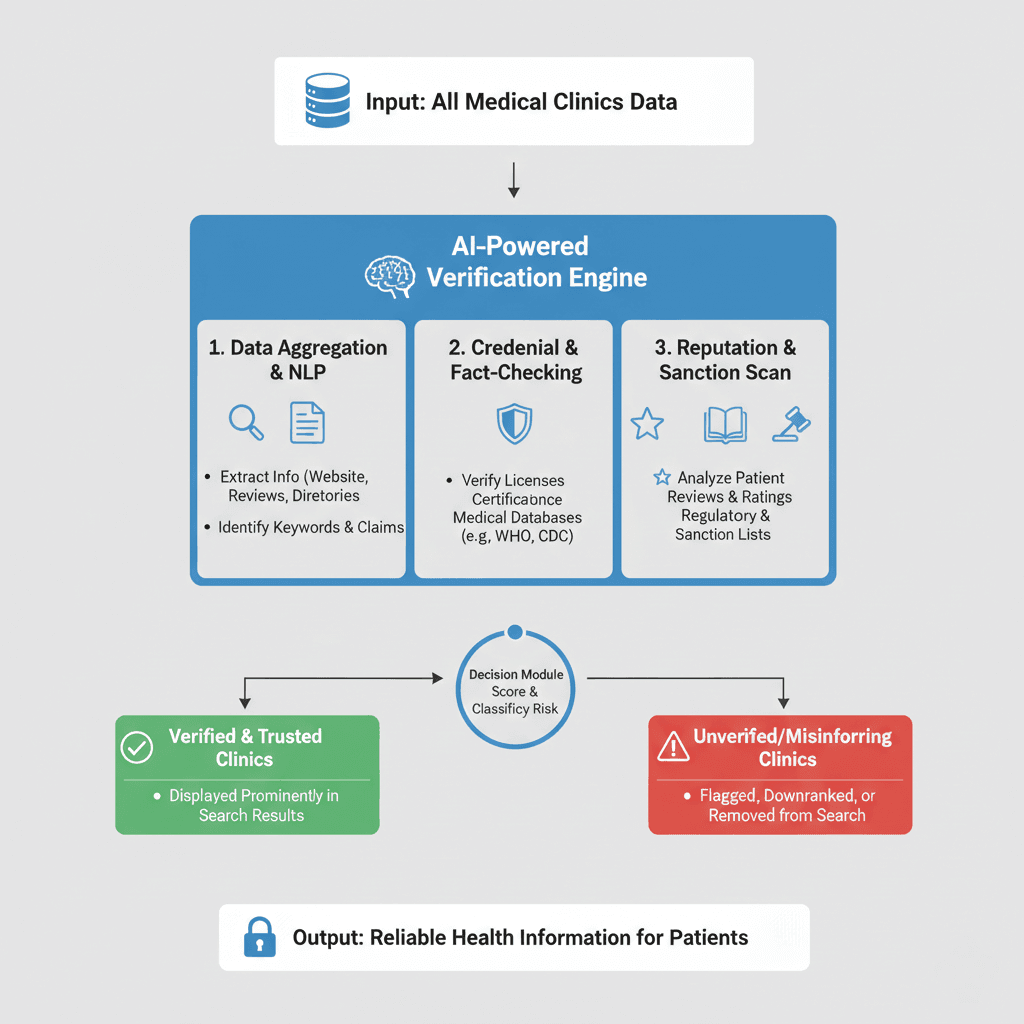
You may also want to read about:
The “GEO” Factor for Clinics (Generative Engine Optimization)
Generative Engine Optimization (GEO) is about becoming the primary source for AI-generated answers.
For high-value facilities like Surgical Centers or Oncology Clinics, this is critical. You want the AI to cite your facility as an “Innovative Leader.”
To achieve this, you must increase the “Statistical Density” of your content. Do not just describe a procedure. Provide recovery statistics, infection rate data (if superior), and technology specifications.
- Bad: “We use advanced lasers.”
- Good: “We utilize the [Specific Machine Name] with a 98% precision rate, reducing recovery time by 3 days.”
| Strategy/Signal | Description | Key Tactics | Primary Platform Focus | Target Outcome | Content Format Requirements |
| Entity Authority | Establishing a verified, consistent, and unambiguous digital footprint that AI models use to build confidence in a brand or professional identity. | Align Name, Address, Phone (NAP) across all platforms; maintain consistent brand definitions; use author bios with credentials; secure unlinked brand mentions in authoritative sources. | ChatGPT, Gemini, Google Knowledge Graph | Brand recognition, citation, and recommendation as a trusted source. | Clear About page; consistent positioning across profiles; use of ‘entity-stable’ paragraphs. |
| Semantic Depth & Topical Coverage | Covering a subject with exhaustive subtopic coverage to answer the entire ‘question tree’ rather than just surface-level keywords. | Use ‘topic clusters’ to group related content; address follow-up questions; include definitions, best practices, and common mistakes. | Perplexity, Google SGE, ChatGPT | Topical authority and inclusion in sophisticated/complex AI answers. | Long-form content (2,900+ words for general, up to 5,000 for medical guides); logical H1-H3 hierarchy. |
| Schema Markup / Structured Data | Standardized code (JSON-LD) that makes E-E-A-T elements machine-readable for programmatic verification by AI crawlers. | Implement specific types: MedicalCondition, Physician, MedicalOrganization, FAQPage, and HowTo schema; link entities to external knowledge bases like Wikidata. | Google AI Overviews, Gemini, Perplexity | Enhanced data recognition, rich snippets, and higher confidence scores for citation. | JSON-LD format in the HTML head; specific attributes like NPI numbers, board certifications, and ‘worksFor’ relationships. |
| Clinical Trust Signals (E-E-A-T) | Explicit markers of Experience, Expertise, Authoritativeness, and Trustworthiness required for Your Money Your Life (YMYL) content. | Visible ‘last medically reviewed’ dates; citations to peer-reviewed journals; physician bylines; links to NPI registry. | Google AI Overviews, Perplexity (Pro Search) | Verification as an authoritative medical source; avoidance of ‘hallucination’ filters. | Review dates (e.g., ‘Last reviewed Jan 2026’); credentialed author bios; links to authoritative external references. |
| Answer Capsules / Micro-Content | A ‘snackable’ formatting strategy where direct, factual responses are placed immediately following a question-based header. | Place a 40-60 word standalone summary at the top of a section; lead with the answer before providing background or methodology. | ChatGPT, Google Featured Snippets, Voice Assistants (Siri/Alexa) | Zero-click answers, featured snippets, and direct extraction by RAG systems. | 40–60 word blocks; placed immediately under H2 question-based headers; concise, neutral language. |
| Content Chunking | Structuring information into discrete, self-contained semantic units that AI can lift and reuse without surrounding context. | Keep concepts within specific word counts; use bulleted lists for scannability; avoid ‘fluff’ and narrative meandering. | ChatGPT, Gemini, RAG-based systems | Ease of extraction and reuse in synthesized AI narratives. | 60–120 words per chunk; one concept per paragraph; include one heading and 3-6 supporting bullets per chunk. |
| Prompt-Aware Strategy | Mapping content directly to the specific intent patterns and conversational formulas used by AI users. | Identify common prompt formulas (e.g., ‘Best X for Y’); create comparison tables; optimize for multi-turn follow-up questions. | ChatGPT, Gemini, Perplexity | Direct inclusion for situation-based and decision-request prompts. | FAQ syntax mirroring user prompts; decision matrices; ‘How-to’ procedural steps. |
This level of detail makes your content highly citable for AI models looking for factual density.
Patient Trust in the Age of AI
AEO is not just a marketing tactic. It is about making your clinic discoverable to the next generation of patients who rely on AI for health decisions.
Local SEO is now AI SEO. By ensuring NAP (Name, Address, Phone) consistency and verifying your data, you build the trust required to be recommended.
Take the first step toward AI visibility. Run your Healthcare AEO Audit and close the gap between your clinic and your patients.
Frequently Asked Questions about Medical AEO
What is AEO for healthcare?
AEO (Answer Engine Optimization) for healthcare is the strategy of optimizing a medical practice’s online data so that AI platforms like Gemini, ChatGPT, and Apple Intelligence can read, verify, and recommend the clinic to patients.
How does AI affect medical practice SEO?
AI affects medical practice SEO by shifting the primary ranking factor from keyword density to entity verification. While traditional SEO focuses on ranking a website, AI platforms look for “trust signals” such as verified NPI numbers, MedicalBusiness schema, and consistent insurance information to prevent giving bad medical advice.
Why is Schema markup important for doctors?
Schema markup, specifically Physician and MedicalBusiness types, acts as a digital ID card. It tells AI search engines exactly what a doctor specializes in and where they are licensed. Without it, AI models may consider the profile “unverified” and skip it to avoid risk.
You may also want to read about: